






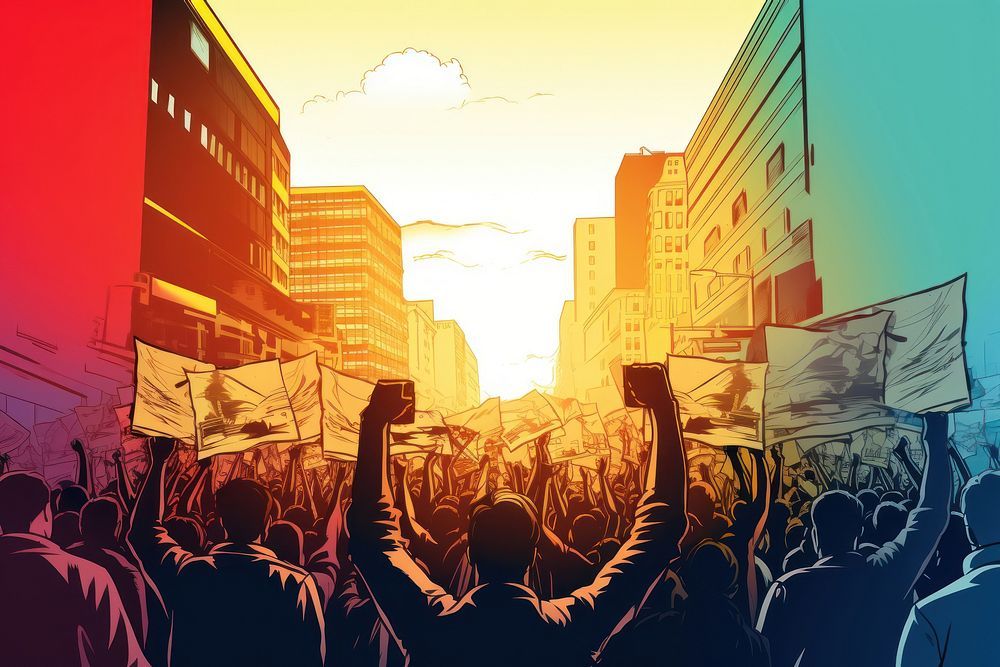
Power, Protest, and the Unbreakable Kenyan Spirit


Democracies rarely die in a single dramatic moment. They erode in increments — one disrupted rally here, one excessive deployment of force there, one unfinished project unveiled with fanfare, one unanswered question about corruption.
But Kenya is not a quiet nation. It does not erode silently.
It argues.
It resists.
It remembers.
And that memory may be the strongest defense of its democracy.
The Day Tear Gas Failed to End a Rally
In Kakamega, when tear gas canisters hissed through the air in an attempt to disperse a political gathering, something remarkable happened. The smoke rose. People scattered. But they did not disappear.
They regrouped.
They returned.
They insisted the rally proceed.
Agree or disagree with the politics of the moment — the symbolism was unmistakable. Tear gas can sting eyes, but it cannot blind conviction. Smoke may cloud the air, but it cannot suffocate constitutional rights.
That scene in Kakamega was not chaos. It was a declaration: Kenya’s political space is contested, but it is not surrendered.
A Constitution Written in Struggle
Kenya’s 2010 Constitution was not printed in comfort. It was forged through decades of activism, sacrifice, detention without trial, civil society mobilization, and relentless calls for reform.
It guarantees:
-
Freedom of assembly (Article 37).
-
Freedom of expression.
-
The right to life.
-
Judicial independence.
-
Devolution of power.
This is not decorative language. It is the backbone of the republic.
When the Supreme Court annulled the 2017 presidential election, it stunned the continent. It proved that no office — not even the presidency — was beyond constitutional scrutiny.
That is not the architecture of dictatorship. That is the blueprint of a conscious democracy.
Democratic Space Is Not Selective
During the presidency of Uhuru Kenyatta, political tensions between him and his deputy, William Ruto, were open and visible. Their alliance fractured publicly after the 2018 political détente known as “the handshake.”
Yet Ruto continued to crisscross the country holding rallies, mobilizing supporters, and positioning himself as a presidential candidate.
He campaigned vigorously.
He criticized policy direction.
He built a movement.
And he won.
That precedent matters.
If democratic space was sufficient for a sitting deputy president to campaign against the prevailing establishment, that same space must remain open for others today.
Democracy cannot be generous only when it is convenient.
Violence Is a Short-Term Strategy With a Long-Term Cost
Across Kenya’s history, goonism and politically linked disruptions have appeared in different seasons. Hired disruptors. Counter-mobilized crowds. Rallies blocked. Protestors teargassed.
The logic is always the same: suppress momentum.
But intimidation rarely secures legitimacy.
Globally, history is blunt on this point. Suppression during South Korea’s democratic uprisings in the 1980s did not prevent reform — it accelerated it. Heavy-handed tactics in parts of Latin America hardened opposition rather than dissolving it. The U.S. Civil Rights Movement grew stronger under state resistance, not weaker.
Fear may scatter a crowd. It does not convert the conscience.
And in Kenya, political memory is long.
Kenya Is Not Uganda. Kenya Is Not Tanzania.
Countries like Uganda and Tanzania have faced international scrutiny over electoral restrictions and opposition limitations in recent years.
Kenya is structurally different.
It has:
-
A devolved system with 47 counties.
-
An assertive judiciary.
-
A vibrant media ecosystem.
-
Active civil society networks.
-
Youth movements capable of organizing in hours.
Kenya argues loudly. It litigates fiercely. It debates endlessly. It protests visibly.
Its elections are messy — but they are contested in courtrooms and scrutinized in public.
The democratic muscle here has been exercised too often to dwindle quietly.
When Citizens Ask Dangerous Questions
When citizens begin asking how to defend themselves against political persecution, the nation stands at a delicate edge.
That question is not born from rebellion. It is born from fear.
But escalation is not the answer.
Kenya has lawful mechanisms of defense:
-
Courts.
-
Elections.
-
Media.
-
Public oversight.
-
Peaceful protest.
If these mechanisms are perceived as shrinking, tension expands.
It is the responsibility of the government — which wields the greater power — to ensure dissent does not feel like criminality.
Because once people feel cornered, stability becomes fragile.
Policing, Protests, and Proportionality
Kenya’s police service has a duty to maintain order. But it also carries a constitutional obligation to respect life and assembly.
Human rights organizations, including Amnesty International Kenya and other civil monitors, have documented protest-related fatalities in recent cycles of demonstrations. Exact figures vary depending on methodology and reporting, but multiple public reports confirm dozens of deaths during waves of protests over taxation and economic grievances.
Each life lost deepens the wound between state and citizen.
Security is not proven by the volume of tear gas deployed. It is proven by restraint under pressure.
A confident government does not fear criticism. It answers it.
The Image Problem: Tear Gas vs. Trust
Optics shape perception.
When rallies are disrupted or church spaces are tense with political friction, it creates a visual narrative of fragility. Churches historically played central roles in Kenya’s democratic evolution — mediating conflict, advocating reform, and sheltering dissent.
If faith spaces and political platforms feel policed rather than protected, moral authority erodes.
Trust is oxygen for governance. Without it, even good policy suffocates.
Chest-Thumping Does Not Build Roads
Governments are not judged by volume, but by value.
By:
-
The price of unga.
-
The availability of jobs.
-
The reliability of healthcare.
-
The completion of infrastructure.
-
The fairness of taxation.
-
The integrity of procurement.
If projects are launched with fireworks but left half-built, citizens notice.
If political leaders appear deeply entangled in business interests while ordinary youth struggle, perception hardens.
Perception, in politics, can become reality.
The Youth Factor: A Generation That Will Not Be Silenced
Kenya’s population is overwhelmingly young. Digitally connected. Economically strained. Politically aware.
When Gen-Z mobilizes, it is not nostalgia. It is urgent.
This generation does not respond well to intimidation. It responds to opportunity, transparency, and fairness.
Suppressing it may delay conversation — but it does not end it.
Intimidation Has Never Permanently Worked Here
Kenya’s second liberation movement of the 1990s overcame repression. The constitutional reform movement overcame inertia. The judiciary overturned a presidential election in 2017.
The pattern is clear:
Push Kenyans too hard, and they push back — through courts, through ballots, through organized civic pressure.
Not always perfectly. Not always peacefully. But persistently.
The Ballot Is Stronger Than the Baton
Governments are elected — not crowned.
They are renewed through performance — not force.
President Ruto himself rose through open contestation. That same democratic oxygen must remain available to others.
Elections cannot be won sustainably by intimidation, disruption, or state overreach. They are won by convincing citizens that:
-
Their taxes are used wisely.
-
Their children have an opportunity.
-
Their rights are respected.
-
Their voices matter.
Ballots leave no bruises.
Batons do.
Kenya Cannot Be Owned
Power in Kenya is not inherited. It is borrowed.
Borrowed from boda boda riders.
From farmers in Kitui.
From traders in Gikomba.
From teachers in Kakamega.
From youth in Nairobi estates who refuse to disappear into smoke.
Kenya cannot be a dictatorship — not because it lacks tension — but because its citizens have tasted democratic agency too deeply.
The Constitution is conscious.
The people are alert.
The memory of struggle is alive.
Final Punchline
Tear gas evaporates.
The Constitution does not.
Fear fades.
Memory remains.
And in Kenya, history has always favored those who trust the ballot more than the baton.


